By Innovatr · ECMO · CPB · NRP
PerfusionPilot OS.
CPB, ECMO and NRP reference for the extracorporeal team
The arithmetic you do at three in the morning, with the source it came from written next to it. Thirty-nine calculators, a case record and a reference library, on the device already in your pocket, working with no signal.
The daily clinical work is free. Always.
iOS. Android in preparation. Reference and education tool, not a medical device.
Cited calculators
Who it is for
An extracorporeal circuit is run by a team.
Cardiopulmonary bypass, VV and VA ECMO, ECPR, normothermic regional perfusion, VAD and mechanical support, organ perfusion and transplant retrieval.
Perfusionist
You run the circuit. Flow, prime, haematocrit, gas and anticoagulation come first.
Intensivist
Oxygen delivery, gas exchange, renal and metabolic values, and the published risk scores.
ICU or specialist nurse
Hourly observation maths, electrolyte corrections and circuit checks, in plain language.
Surgeon
Sizing, flow targets, cardioplegia and cerebral protection come first.
Trainee
The same figures as everyone else, with more of the reasoning shown.
Everyone gets the same calculations, the same citations and the same guidance. Choosing a role changes what appears first and how much is explained in everyday words. It never restricts what you can open. There is no clinical content behind a role, and no role sees a number another role cannot.
What is free, forever
The daily clinical work is free and stays free.
All 39 calculators. Your case log. The reference library. The recertification logbook.
No trial on any of it. No seat count. No feature held back for a plan.
We charge for the things that only make sense once you have a history behind you, never for the arithmetic you need in the middle of a case.
Also free: therapy-specific checklists · ECMO daily rounds with a complication watchlist · anticoagulation and circuit-integrity records · ABG and report entry · one-tap de-identified run, handover and M&M reports as branded PDF or Word · quality and documentation review · notes.
The clinical toolkit
Thirty-nine calculators, grouped the way a clinician thinks.
Flow and sizing
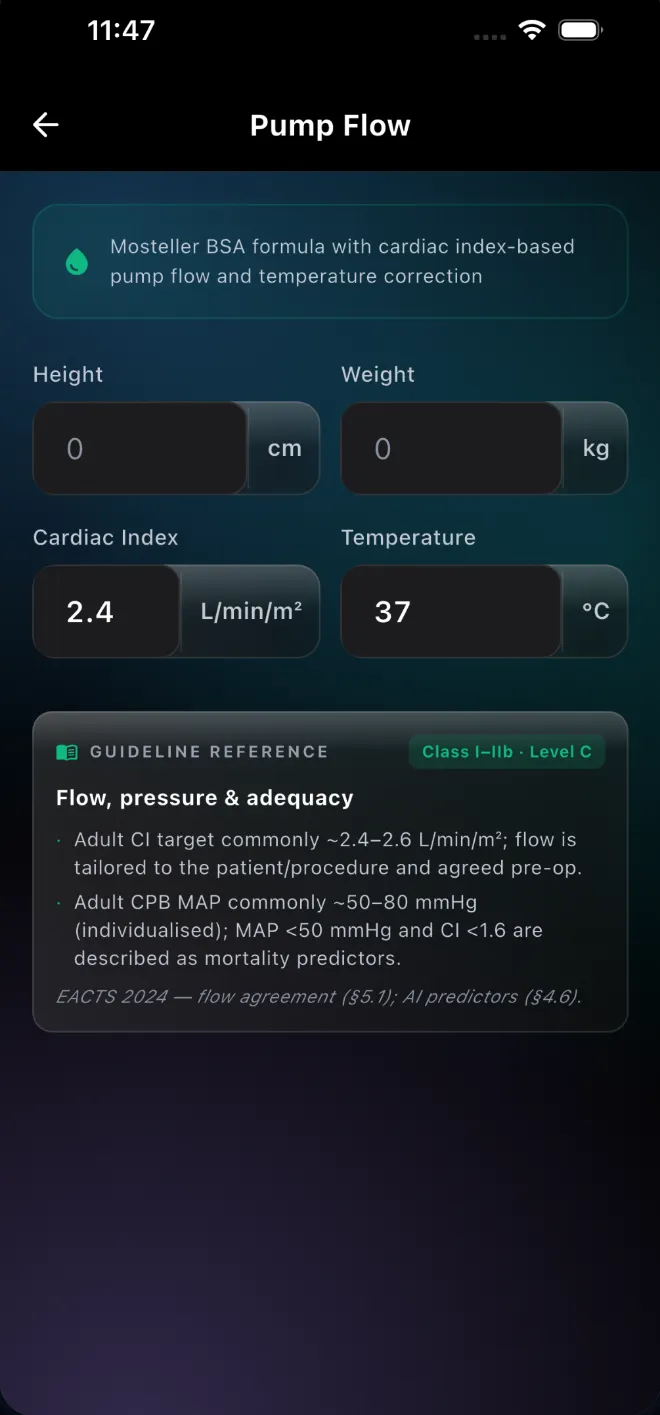
pump flow and cardiac index · BSA by three published formulae · paediatric flow bands · tubing and cannula sizing · cerebral perfusion pressure
Oxygen delivery
DO₂ index · VO₂ and oxygen extraction · Fick cardiac output · venous saturation · P/F ratio and oxygenation index · air:O₂ blender
Haematology
dilutional haematocrit · blood volume · RBC volume for a target haematocrit · ultrafiltration, with the oncotic pressure your planned removal would leave behind · acute normovolaemic haemodilution · haemolysis index
Coagulation
ACT · heparin dose-response by the Bull method · heparin remaining after a dose · antithrombin · bivalirudin · protamine
Chemistry
anion gap · corrected calcium · osmolality · potassium correction, with the published rate band once you enter a duration, and sodium correction rate against the published 24-hour ceiling · base and bicarbonate · oncotic pressure · creatinine clearance
Circuit
prime volume · oxygenator ΔP · VV-ECMO recirculation · cardioplegia
Scores
RESP · SAVE, each shown as a published population statistic and never as a prediction for the patient in front of you
Where the numbers come from
Where a figure comes from a published guideline, the guideline is named on the screen. Where no single source states a figure, the app says so rather than implying one.
That second sentence took the most work. Several figures clinicians use daily are not in any single guideline, they are convention. The app tells you which is which, and where a source disagrees with the convention, it shows you both.
It reads what you typed
Enter a value in the wrong unit and the app says so before it calculates. A haemoglobin of 130 in a field expecting g/dL, a PaO₂ of 100 in a field expecting kPa: it offers the value it thinks you meant.
Where a number could plausibly be either, it declines to guess rather than quietly correcting you.
In your language
The interface is in 102 languages, and 1,610 strings are translated into every one of them with no gaps. That goes past the labels. Where the app tells an English reader that a RESP or SAVE figure is a population statistic for reference and education, and not a prediction for an individual patient, a Japanese or Arabic reader sees that same sentence in their own language.
Not all of it, yet. The full not-a-medical-device disclaimer, and the reference card that sits on those same score screens, still render in English everywhere. The plain-language clinical explanations are held in English on purpose, because we do not ship machine-translated clinical text. The language picker says so, in the reader's own language.
Inside the app
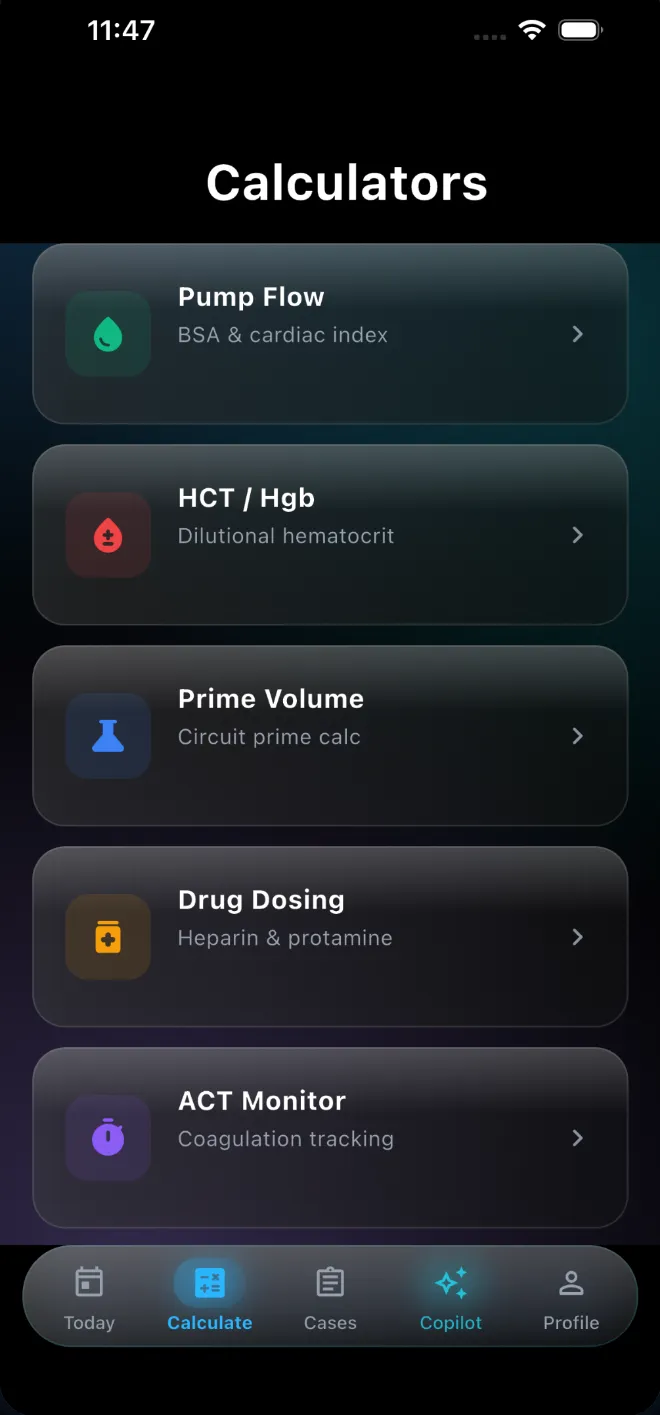
Five screens. Zero clutter.
A glimpse. The rest is better with your own cases in it.
39 cited calculators: the equation, the units, the source.
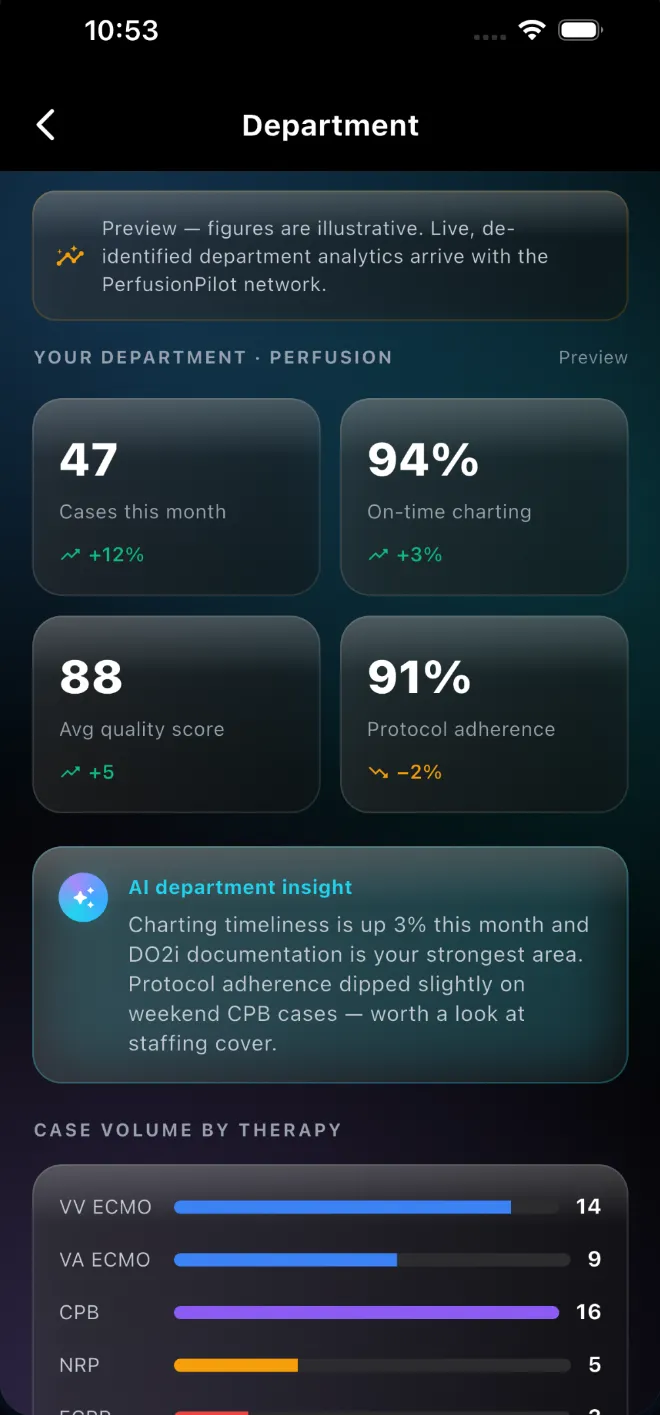
See the trend at a glance.
Pump flow, DO₂i, prime, ACT and more.
For the department
One case. Every screen in the room.
Turn sharing on and each vital you type is sent to the other devices working that case, updating as you work. A value typed at the pump appears on the screen at the head of the bed, carrying the time it was typed and the device it was typed on, so a handover becomes a record rather than a recollection.
No server, because a theatre is where a cloud round-trip fails you.
Devices find each other by UDP broadcast on the local network and send changes directly to one another. Where a network blocks broadcast, a device can be paired by address.
The merge is order-independent, duplicate-safe and batch-independent, so changes arriving late, twice or out of order all resolve to the same record. The room's screen always states how many other devices it can currently hear, and an empty room says so plainly rather than looking like a working connection.
A shared record, not a patient monitor.
The heart-lung machine console and the ECMO console remain the monitor. Every figure on the shared record is one a person typed, and the app shows you who typed it and when.
Sharing is off until someone turns it on. No patient names, dates of birth or record numbers exist in the app, so none are transmitted.
What travels, and what does not.
Vitals travel. Checklist ticks, notes and the case header stay on the device that typed them.
Only what you type after the switch goes on is sent, so a case you filled in earlier is not pushed to anyone, and the other device has to already have the same case open for anything to land.
Departmental and organisational licensing
Multiple seats, one agreement, invoiced. Tell us about your unit and we will come back to you.
Enquire about departmental licensingHow we handle being wrong
Every calculation can be challenged.
A flag on every result opens a report: what you expected, and the source you are going by. A person reads every one.
That is the whole differentiator, and we would be glad to be copied.
A report never changes a formula automatically.
Clinical formulas come from published sources; they are not crowdsourced. If fifty clinicians report that a number looks low, what changes is that somebody re-derives the implementation against its citation, not the number.
Every formula is signed off, and the sign-off expires.
Each one is listed on a clinician sign-off sheet with its implementation, its sources, and a hash of its code. A sign-off holds until the maths changes, and then it expires.
Edit a formula and its signature reverts automatically, including when the edit provably changes no result. We would rather ask a clinician to sign the same number twice than let a changed one through on an old signature.
Privacy, by construction
Patient identifiers never leave the device.
PerfusionPilot is de-identified by design. Cases are recorded with age band, therapy and outcome, never a name, never an MRN, never a date of birth. Your own private notes are encrypted on the device before anything is stored.
When a department contributes to the pooled databank, aggregates are released only if they pass every one of these tests: at least 30 distinct cases and 5 contributing institutions per figure, no institution making up more than 20% of it, at least three distinct value bands surviving, and a minimum cohort size. Individual counts are never published, only which bands occur. Figures are frozen for 24 hours so repeated queries cannot be compared to isolate a single case.
If a cohort does not meet that bar, nothing is shown. We would rather show you less than risk showing you someone.
See it for yourself
The app’s navigation, live.
Thirty of the 102, from Spanish and Mandarin to Swahili, Tagalog and Uyghur. Pick one and the five tabs change with it, right to left where the language runs that way.
The app’s navigation, live in English
- …and 70 more
Your units.
Six independent switches: kPa or mmHg, g/dL or g/L, lactate in mmol/L or mg/dL, °C or °F, kg or lb, cm or in. Run mmHg and °F while keeping mmol/L lactate. The maths always runs in canonical units, so changing a display can never change a result.
Your seat.
First launch asks one question: perfusionist, intensivist, nurse, surgeon or trainee. Your answer reorders your tools and sets the reading level. It never gates a feature, never hides a calculator and never changes a number.
Plain English, on request.
Every one of the 39 calculators has a written plain-language explanation of what the number is and why the team looks at it. On by default for nurses and trainees, available to anyone, and shareable as a one-page card that cannot contain patient data.
Availability
iPhone and iPad. Android in preparation.
Optimised for one-handed use at the bedside, with a full-width layout on iPad.
Perfusionists first, the whole circuit team alongside.
Perfusionists first: the clinical depth is built to their standard, and the calculators, circuit records and recertification logbook are theirs. But an ECMO circuit is run by a team: intensivists reviewing oxygen delivery, nurses logging hourly observations, surgeons at cannulation, trainees learning what the numbers mean. The same reference serves all of them, and every calculation shows its equation and citation so no one has to take it on trust.
A reference tool, by design.
PerfusionPilot OS is a reference and education tool. It is not a medical device and does not diagnose, treat or monitor. Clinical decisions rest with the treating team.
Questions, answered
The honest FAQ.
What is PerfusionPilot OS?
PerfusionPilot OS is CPB, ECMO and NRP reference for the extracorporeal team. 39 clinical calculators, therapy-specific checklists and cited reference material, on the device already in your pocket, working with no signal.
Who is it for?
An extracorporeal circuit is run by a team, so there are five seats: perfusionist, intensivist, ICU or specialist nurse, surgeon and trainee, across cardiopulmonary bypass, VV and VA ECMO, ECPR, normothermic regional perfusion, VAD and mechanical support, organ perfusion and transplant retrieval. Everyone gets the same calculations, the same citations and the same guidance. Choosing a role changes what appears first and how much is explained in everyday words. It never restricts what you can open.
How many calculators are there?
39, grouped the way a clinician thinks: flow and sizing, oxygen delivery, haematology, coagulation, chemistry, circuit, and the published RESP and SAVE scores. Where a figure comes from a published guideline, the guideline is named on the screen. Where no single source states a figure, the app says so rather than implying one.
Does it work offline?
Yes. Every calculation, case, checklist, report and the recertification layouts all run on the device, with no account and nothing to sync. The one thing that uses a network is sharing a live case with the other devices in the room, and that runs over the local network with no server.
Is PerfusionPilot a medical device?
No. PerfusionPilot OS is a reference and education tool. It is not a medical device and does not diagnose, treat or monitor. Clinical decisions rest with the treating team.
Does patient data ever leave the device?
PerfusionPilot is de-identified by design. Cases are recorded with age band, therapy and outcome, never a name, never an MRN, never a date of birth. Your own private notes are encrypted on the device before anything is stored.
What is free?
The daily clinical work, and it stays free. All 39 calculators, your case log, the reference library and the recertification logbook. No trial on any of it, no seat count, no feature held back for a plan. No account required, no signal required.
What does Premium add?
Your recertification, laid out against your board's requirements: the UK College's five-field logbook, a bulk case list for ABCP, or an EBCP Form Ia style list, with a case-mix summary and a warning about blank required fields before you file. The app copies the rows to your clipboard, ready to paste into whatever form your board actually wants. It compiles the entries you typed, certifies nothing, and is not a submission. Premium also adds the Morning Brief, a short read on each live case built only from your own recorded trajectory and the published guidance, every claim cited. A 7-day free trial is available on the annual plan.
Can my department use it?
Yes. Turn sharing on and each vital you type is sent to the other devices working that case, updating as you work, carrying the time it was typed and the device it was typed on. It runs over the local network with no server, because a theatre is the one place a cloud round-trip is unavailable exactly when you need it. Only vitals travel, only from the moment the switch goes on, and only into a device that already has the same case open. It is a shared record, not a patient monitor: the heart-lung machine console and the ECMO console remain the monitor, and every figure on the record is one a person typed. Sharing is off until someone turns it on. Departmental licensing is multiple seats on one agreement, invoiced; tell us about your unit and we will come back to you.
What if a number looks wrong?
Flag it. A flag on every result opens a report: what you expected, and the source you are going by. A person reads every one. A report never changes a formula automatically, because clinical formulas come from published sources and are not crowdsourced. What changes is that somebody re-derives the implementation against its citation.
What languages does it support?
The interface is translated into 102 languages, from Spanish and Mandarin to Swahili, Tagalog and Uyghur, with right-to-left support for Arabic, Hebrew, Farsi and Urdu. Clinical content deliberately remains in English, because machine-translating clinical guidance is not safe.
Where can I get it?
iPhone and iPad, with Android in preparation. A signed build is ready for TestFlight; the App Store listing is not published yet. Email hello@innovatr.health to request early access.

Open it every shift.
A signed build is ready for TestFlight. Tell us who you are and we will get you set up.